
When Everything Gets Shaken
On embracing hardship and responding in difficult times

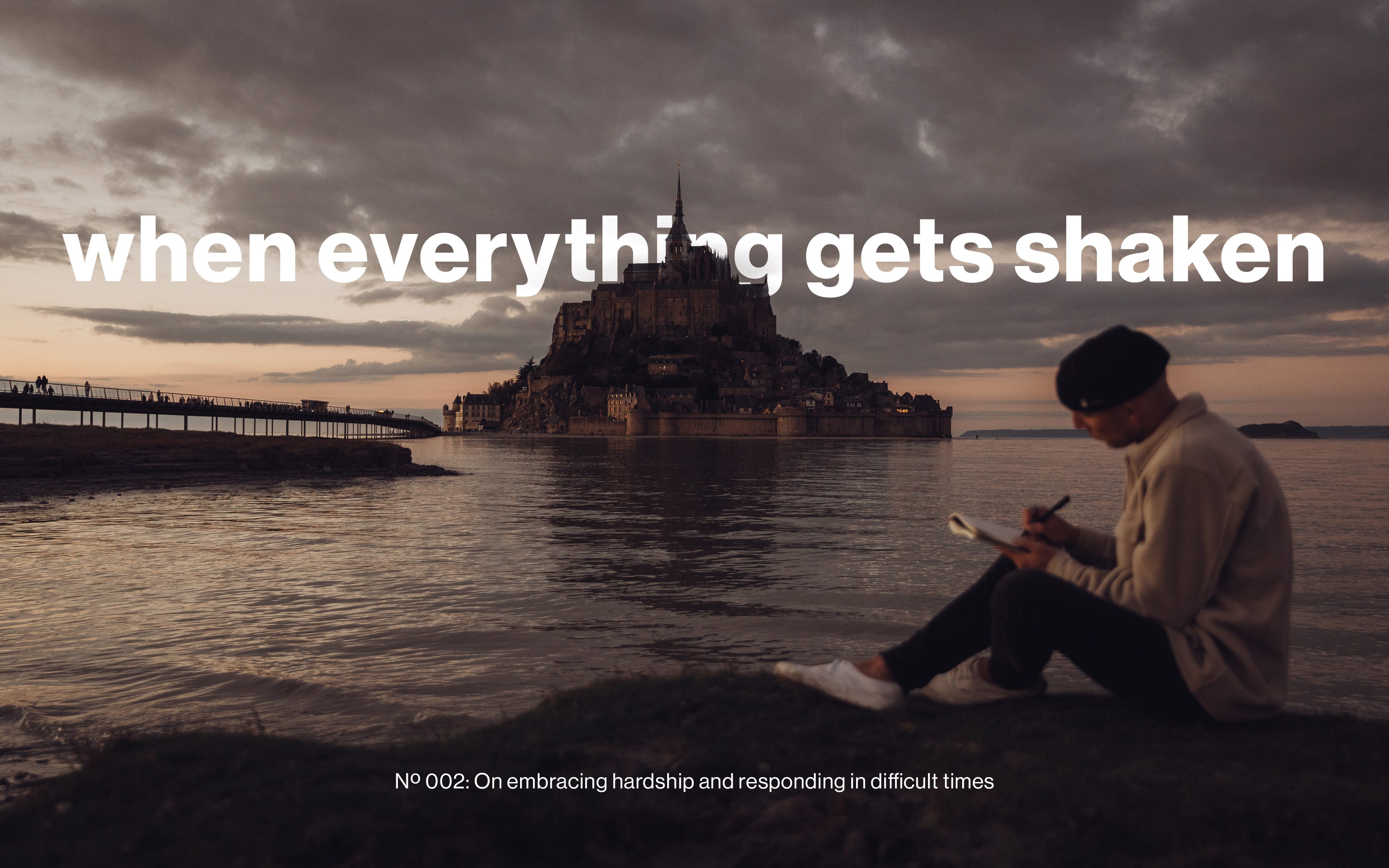
“Life is difficult. This is a great truth, one of the greatest truths. It is a great truth because once we truly see this truth, we transcend it. Once we truly know that life is difficult - once we truly understand and accept it - then life is no longer difficult. Because once it is accepted, the fact that life is difficult no longer matters.”
- M.Scott Peck
It’s been a rough few years…
Maybe it’s just me, but doesn’t it just feel like we’ve had to face one hard thing after another these last few years? If it wasn’t the pandemic or economic crisis, it was natural disasters, wars, shootings, numerous injustice-driven nation and world-wide protests, inflation, culture wars, and the pin-balling of global political ideology to name a few. Let’s not even start with the existential threat so many fear from AI and how far the pendulum might swing from utopian to dystopian based on the decisions being made at this point in history. As I write this, a lot feels up in the air. And if I’m honest, that’s not even the stuff that shakes us most.
For many of us, these last few years have also brought their fair share of personal tragedies, loss, trauma, and heartache. I’ve watched a number of people close to me navigate the end of decades-long relationships and marriages. Seen multiple memorial services for men and women who left this world long before their time. Watched burnout and exhaustion take out so many respected leaders, entrepreneurs, and creative visionaries all while watching in my own life as I fought those very same culprits. Very few (if any) of us have come out of these last few years unscathed.
How do we respond when it feels like everything we’ve found our footing on starts to shift? When the ground beneath our feet feels a lot less sturdy than it once did?
When everything gets shaken, we are presented with a path. A familiar set of choices that start the minute that familiar feeling of fear hits. Like subway stops en route to a destination - we get to choose to get off and stay or continue past each one of these to reach the other side. Here’s the sequence, with a few words on each below.
Fear → Avoidance → Acceptance → Embrace
Stop 1: Fear
When everything gets shaken fear is the first one knocking at the door. “Am I lying to myself?”, “Am I the problem?”, “Is the best already behind me?”. The specific self-talk is different for each of us, but even after years of “knowing better” it’s still there, quietly whispering. It’s here that we often see perfectionism, ego, comparison, and imposter syndrome all slide in as competing dance partners compounding the feeling of destabilization.
That’s usually the first stop. Feeling it is normal. Staying in it is a choice. Most find ways to keep moving though, and while an extended stay here can be nearly debilitating, the bigger trap lies at the next stop.
Stop 2: Avoidance
The reality is, staying at stop #1 is something very few of us do for long (however, many loop back to that stop with regularity). Fear presents us with something that requires an action. That first choice is to face the fear and the reality of the situation(s) we’ve been presented with, or try to pretend or avoid the reality of everything that is changing.
Avoidance is one of humanity’s favorite ways to cope in these seasons because it’s also quite successful albeit in the short term. M. Scott Peck who was quoted off the top points out, “The tendency to avoid challenges is so omnipresent in human beings that it can properly be considered a characteristic of human nature. But calling it natural does not mean it is essential or beneficial, or unchangeable behavior. It is also natural to defecate in our pants and never brush our teeth. Yet we teach ourselves to do the unnatural until the unnatural becomes itself second nature. Indeed, all self-discipline might be defined as teaching ourselves to do the unnatural. Another characteristic of human nature - perhaps the one that makes us most human - is our capacity to do the unnatural, to transcend and hence transform our own nature.”1
Like many, I am a self-admitted master of avoidance. One of the hard lesson’s I’ve learned in my own life and watching the lives of others play out around me is that eventually reality must be faced. You can only run for so long, and those that find a way to keep out-running longer than most, usually discover a life that starts to feel less and less like they’re really living. A prolonged stay at this stop often leaves us numb to the negative feelings and fear (which was why we stopped here), but with the tragic side effect of also numbing most of the joy and excitement and other feelings that make life worth living.
Stop 3: Acceptance
At some point, after either a quick stop or an extended stay in avoidance (or a few loops back in and out of fear), we will find ourselves at acceptance. The problem for many of us lies in the way our expectations have been framed and constructed. Just reaching a place of acceptance is made difficult because we have regularly been taught to believe that life “should” look a certain way. That a + b = c. That because the “American dream” looked a certain way for one person, that it should look like that for us too. Social media has become absolutely deadly in perpetuating this problem.
“Happiness equals reality minus expectations”
―Tom Magliozzi
So we are faced with the temptation to avoid reality for much longer than we should because we’d like to believe that order and chaos aren’t two sides of the same coin. Shinzen Young offers another formula to demonstrate the exponential effect that avoidance can bring: “suffering = pain x resistance”.
Reality, however, presents us with the understanding that living well means experiencing the continued inescapable yin and yang of both order and chaos. To live is to accept the entirety of order and chaos and recognize that we get to choose not only to accept that reality but contribute to one or both.
Accepting that life is hard and that chaos isn’t something that can ever be fully eradicated is a more healthy stop than dwelling in avoidance, but if we stay there for too long, we can find ourselves in a state that feels a little like indifferent fatalism. While it can be liberating to no longer try to control that which we can’t control, we have seen throughout history that beauty and joy can be found even in the midst of the most difficult circumstances.
To fully engage with the world around us when everything feels unstable requires something more than just acceptance.
Stop 4: Embrace
There’s an ancient latin phrase, amor fati, which roughly translates to “a love of fate”.
Friedrich Nietzche had a mixed bag of ideas and philosophy (frankly like many intellectuals) but he, along with the Stoics, frequently came back to this idea. "My formula for greatness in a human being,” he said, “is amor fati: that one wants nothing to be different, not forward, not backward, not in all eternity. Not merely bear what is necessary, still less conceal it — all idealism is mendaciousness in the face of what is necessary — but love it"
Joseph Campbell, famous for his work “The Hero’s Journey” echoed these sentiments saying, “Furthermore, the more challenging or threatening the situation or context to be assimilated and affirmed, the greater the stature of the person who can achieve it.”
We are shaped and formed by difficult things.
As we travel from Fear to Avoidance and on through Acceptance, we come to see that growth and change comes from the ability to not only accept the new and difficult realities that have been handed to us, but to embrace them. To ask not how we can make them go away, or return to “how things were” or to that which was “comfortable”, but grow through them. To embrace all of reality and recognize that it is in the full spectrum of our awareness that we discover just how beautiful all of this can be.

Words like embrace, or the concept of amor fati point to a word we hear a lot in February that can lose its strength when washed in consumerism and cliché. Love. I grew up in church, and as I write these words I am reminded of an oft quoted passage of scripture that says, “There is no fear in love, but perfect love casts out fear.” Fear pushes us to withdraw or pull away in the face of difficulty, “love” has always involved a call to “lean in”.
When everything around us gets shaken, we are presented with a path. We can seek temporary comfort in a pattern of fear and avoidance that will lead to an eventual sputtering anxiety-racked burnout, or we can accept and embrace all of what is.
Beyond just surviving or “getting through” the winter seasons of our lives, in accepting, embracing, and even choosing to love the difficult seasons we find that it is through that choice that we change for the better. It is through those “winters” that we come out transformed. Is it easy? Not at all. Facing the hard things of life is hard.
In her book Wintering2,
offers the following encouragement as we face the inevitable ebb and flow of the problems, challenges, and hard things in life.“To get better at wintering, we need to address our very notion of time. We tend to imagine that our lives are linear, but they are in fact cyclical. I would not, of course, seek to deny that we gradually grow older, but while doing so, we pass through phases of good health and ill, of optimism and deep doubt, of freedom and constraint. There are times when everything seems easy, and times when it all seems impossibly hard. To make that manageable, we just have to remember that our present will one day become a past, and our future will be our present. We know that because it’s happened before. The things we put behind us will often come around again. The things that trouble us now will often come around again. Each time we endure the cycle, we ratchet up a notch. We learn from the last time around, and we do a few things better this time; we develop tricks of the mind to see us through. This is how progress is made. In the meantime, we can deal only with what’s in front of us at this moment in time. We take the next necessary action, and the next. At some point along the line, that next action will feel joyful again.”
How do we walk through those seasons when everything gets shaken? We simply take the next step forward. Seek wisdom to do the next right thing. Show up one more time. Create the art, make the video, write the essay, take the photo, create the business, try again. We ask for help. We find support in community and connection and togetherness. And when we’ve lived through a few more seasons, and winter comes again, we’ll be ready. Because we’ve faced fear before and came out the other side. Not unscathed, but stronger, more refined.
More alive.
The Road Less Traveled, by M. Scott Peck | A timeless work with a mix of psychology, spirituality, and first hand experience heavily tied into the idea of how we face reality in all aspects of our lives.
Loved how you wrapped this with so much hope <3
Amazing words by an amazing human. Thank you for this